Direct answer
Pea Gravel Calculator: what the result means
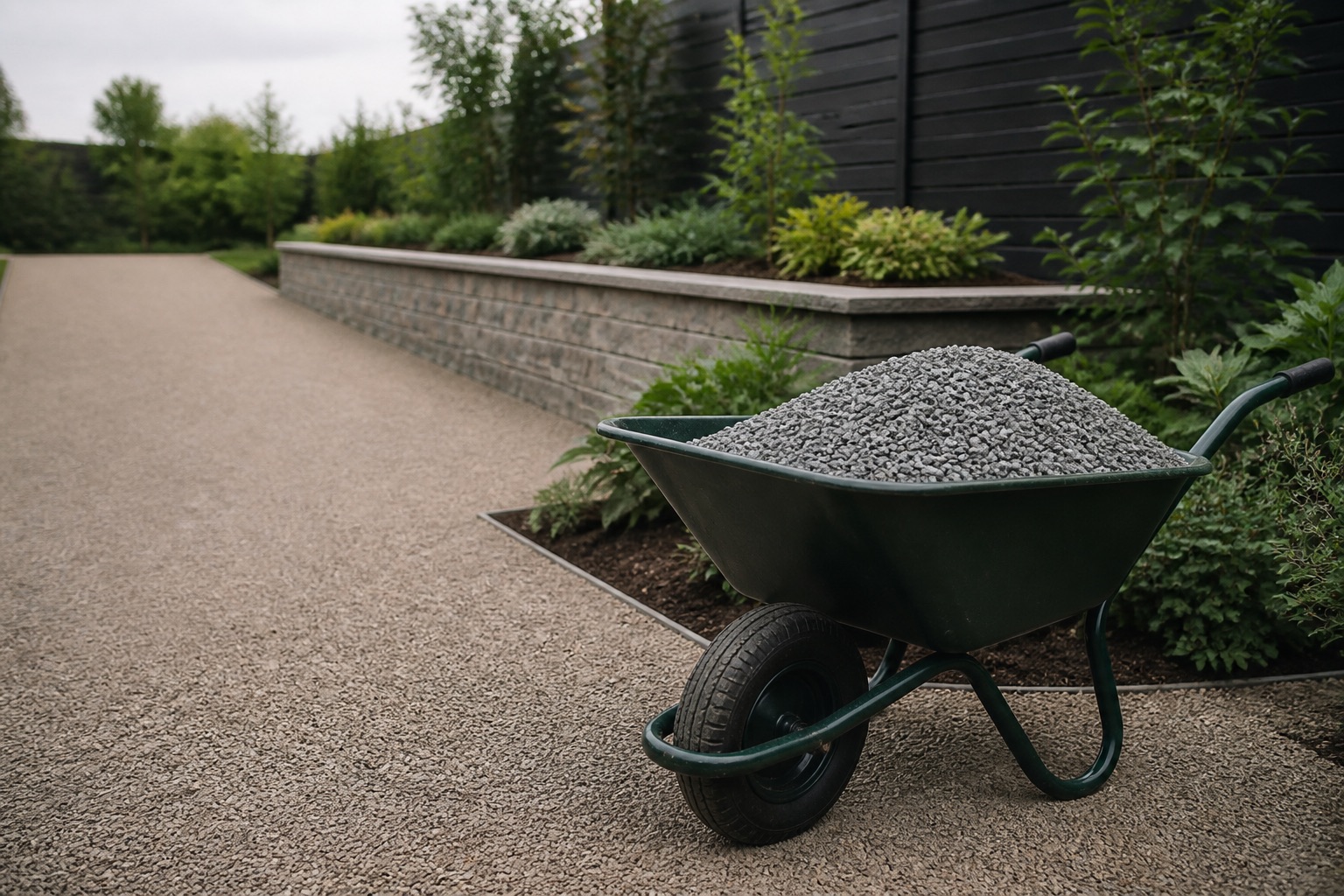
Estimate the volume of pea gravel required for a measured path, border or drainage strip. Confirm the actual product grading because “pea gravel” is a supplier description, not one universal particle specification.
Where this calculation is useful
Typical measurement contexts include narrow paths, decorative borders and contained drainage areas. Suitability for a particular drainage or load-bearing use must come from the project requirement.
How to measure this project
For winding paths, divide the centreline into short reaches and record an average width for each reach. Multiply each reach separately rather than using the widest point for the whole path.
Product and terminology distinctions
Pea gravel is generally associated with small rounded particles; crushed stone has angular particles and different performance characteristics. The calculator does not make them equivalent.
Worked example
A path is divided into two rectangles: 6.5 m × 0.9 m and 3.2 m × 1.1 m. Combined area is 5.85 + 3.52 = 9.37 m². At an entered 45 mm depth, or 0.045 m, volume is 0.42165 m³.
The example uses geometry only. It does not insert a density, package size, recommended depth or supplier tolerance.
How to discuss the result with a supplier
Confirm nominal particle size, washed or unwashed description, and the unit sold. Rounded gravel may be quoted by mass, loose volume or defined bags.
Limitations
It does not determine edge restraint, drainage design, accessibility or suitability under loads.
Common mistakes
- Using total path length with only its maximum width
- Assuming pea gravel has the same definition in every market
- Copying a crushed-stone density into the estimate
Practical planning checks
- Measure changing path widths by reach
- Confirm containment and intended use
- Match the quotation’s particle description
Pea Gravel Calculator questions
Can I use this for a curved path?
Yes, by dividing the path into short measured reaches or defensible simple shapes.
Is pea gravel weight exact?
No. Weight is estimated only from the supplier density you enter.
Related calculators
Compare this result with Gravel Calculator, River Rock Calculator, Landscape Rock Calculator. Each calculator keeps its own material or project terminology while using the same transparent geometry.
Related help
Review BulkMeasure’s calculation methodology, learn how to measure an area, and read about volume, density and estimated weight. Browse the calculator directory when another material or project better matches the job.